ViTraS: Supporting Body Image Therapy with eXtended Reality

ViTraS: Supporting Body Image Therapy with eXtended Reality

Apr 15, 2019 - Dec 31, 2022·
Erik Wolf
Erik Wolf

Summary

The ViTraS project was a BMBF-funded research initiative led by the University of Würzburg. Its main goal was to explore how eXtended Reality (XR) can support improving outcomes in therapy for body image disorders. The project focused especially on obesity, a major global health challenge with significant health and socioeconomic impacts, where relapse after weight loss is common. ViTraS investigated how XR’s unique capabilities could foster body awareness, improve body perception, motivate healthy eating behaviour, and enhance therapy engagement by supporting realistic goal setting.

Motivation

Obesity is a complex health issue involving both physiological and psychological factors, such as reduced body awareness, distorted body image, and low self-esteem. Effective treatment benefits from integrated psycho-physical approaches, not just isolated interventions. Previous investigations on XR-based treatments for these disorders showed promise, but often lacked immersion, realistic self-representations, or interactive, first-person experiences. ViTraS addressed these gaps by developing photorealistic, modifiable, embodied avatars and active, goal-oriented interaction techniques.

Concept

To address prior limitations, ViTraS focused on two main XR exposure experiences, utilizing XR-specific effects as key factors for behavioral and perceptual adaptations:

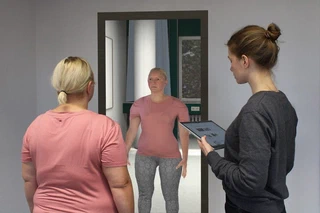
  • Mirror exposure in XR: Participants interacted with a realistic self-avatar in a virtual mirror, dynamically adjusting weight and body shape. This allowed them to visualize self-perception, calibrate therapy goals, and safely explore “what-if” scenarios.
  • Self-sketch, self-touch, and body swapping exercises in XR: Multisensory interactions enabled haptic and visual engagement with the avatar, supporting richer embodiment and subjective feedback for reflection and therapeutic dialogue.

Both concepts emphasized first-person experiences with personalized, high-fidelity avatars and interactive features, aiming to heighten emotional salience, deepen the sense of ownership, and translate insights into real-world motivation and action.

Technological Approach

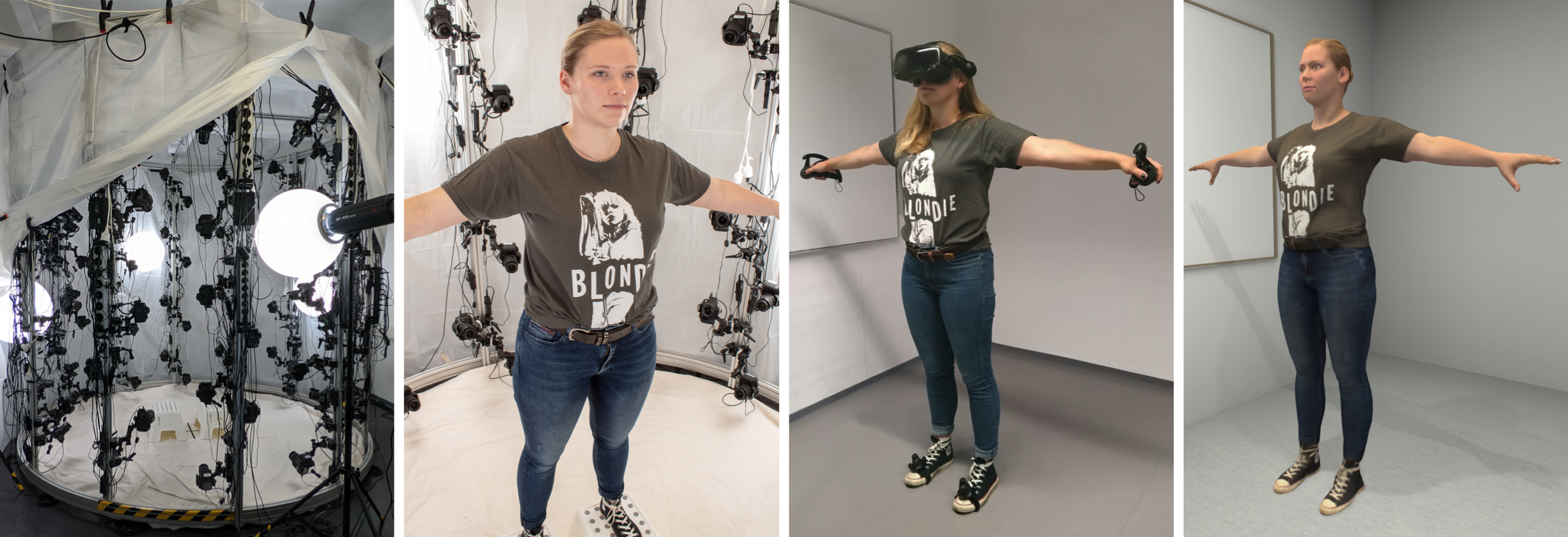
  • Photorealistic Avatars: ViTraS started with a 360° DSLR rig and avatar reconstruction pipeline, later moving to a 180° multi-view system (front, right, back, left) for a more accessible setup. Ultimately, a smartphone-based method was developed, achieving realistic avatars with minimal hardware requirements, making the technology more scalable and affordable. Human to Virtual Human
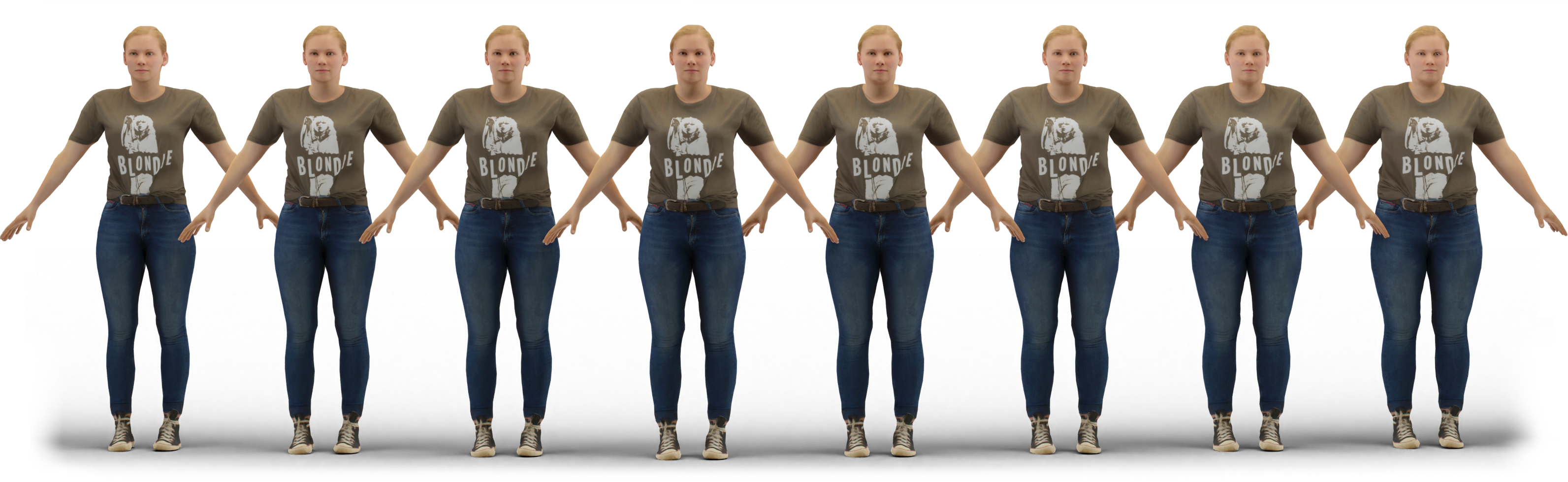
  • Body Weight Manipulation: To enable interactive weight change in XR mirror exposures, ViTraS used a statistical model based on the CAESAR body-scan dataset and a principal component analysis (PCA) to identify shape directions linked to weight. Adjustments were refined to preserve facial identity, so users could explore body changes without losing self-recognition. Body Weight Modification
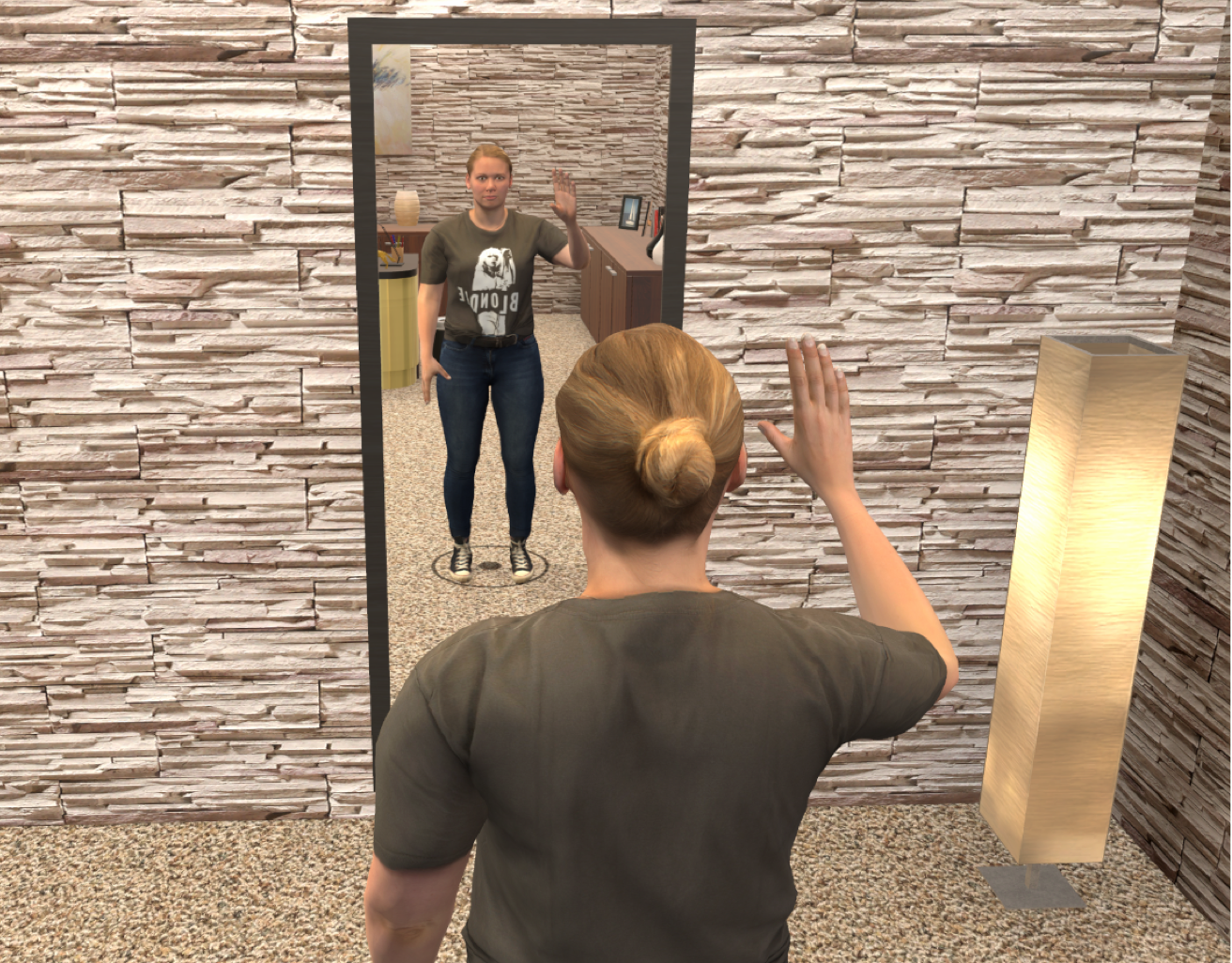
  • Avatar Embodiment in XR: The developed ViTraS application relies on a modular Unity architecture, with reusable components for tracking, avatar retargeting and animation, networked distribution, and rendering on different XR devices. Body tracking evolved from marker-based to markerless multi-camera systems, reducing bodily intrusion and increasing comfort and accessibility. Interaction surfaces and controls were designed to be easy to use for people facing mobility limitations, as is often the case with obesity. Mirror Exposure
Outcomes and Impact

ViTraS resulted in more than 30 peer-reviewed scientific publications in top venues. The project demonstrated that XR can be tailored to the psycho-physical needs of individuals with obesity, showing high acceptance and strong therapeutic potential. The results established foundations also for applications in related disorders, such as anorexia nervosa. ViTraS received notable awards and media coverage, reflecting its scientific merit and societal relevance.

Media

ARD featured ViTraS in their documentary “Mein Körper. Mein (Mehr-) Gewicht”.

2025

(2025). Virtual Body Image Exercises for People with Obesity – Results on Eating Behavior and Body Perception of the ViTraS Pilot Study. BMC Medical Informatics and Decision Making.
(2025). Do You Feel Better? The Impact of Embodying Photorealistic Avatars with Ideal Body Weight on Attractiveness and Self-Esteem in Virtual Reality. 2025 IEEE Conference on Virtual Reality and 3D User Interfaces Abstracts and Workshops (VRW).
(2025). Avatars for the Masses: Smartphone-Based Reconstruction of Humans for Virtual Reality. Frontiers in Virtual Reality.

2024

(2024). Virtual Body Swapping: A VR-Based Approach to Embodied Third-Person Self-Processing in Mind-Body Therapy. 2024 CHI Conference on Human Factors in Computing Systems.
(2024). Towards an Altered Body Image Through the Exposure to a Modulated Self in Virtual Reality. 2024 IEEE Conference on Virtual Reality and 3D User Interfaces Abstracts and Workshops (VRW).
(2024). From Avatars to Agents: Self-Related Cues through Embodiment and Personalization Affect Body Perception in Virtual Reality. IEEE Transactions on Visualization and Computer Graphics.
(2024). From 2D-Screens to VR: Exploring the Effect of Immersion on the Plausibility of Virtual Humans. CHI 24 Conference on Human Factors in Computing Systems Extended Abstracts.
(2024). Am I the Odd One? Exploring (In)Congruencies in the Realism of Avatars and Virtual Others in Virtual Reality. Frontiers in Virtual Reality.

2023

(2023). The Impact of Avatar and Environment Congruence on Plausibility, Embodiment, Presence, and the Proteus Effect in Virtual Reality. IEEE Transactions on Visualization and Computer Graphics.
(2023). Holographic Augmented Reality Mirrors for Daily Self-Reflection on the Own Body Image. CHI 2023 WS28 Integrating Individual and Social Contexts into Self-Reflection Technologies Workshop.
(2023). Embodiment and Personalization for Self-Identification with Virtual Humans. 2023 IEEE Conference on Virtual Reality and 3D User Interfaces Abstracts and Workshops (VRW).
(2023). Auswirkung von (virtuellen) Körperbildübungen auf das Ernährungsverhalten von Personen mit Adipositas – Ergebnisse der ViTraS-Pilotstudie. Adipositas - Ursachen, Folgeerkrankungen, Therapie.
(2023). Are Embodied Avatars Harmful to our Self-Experience? The Impact of Virtual Embodiment on Body Awareness. 2023 CHI Conference on Human Factors in Computing Systems.
(2023). “If It’s Not Me It Doesn’t Make a Difference” – The Impact of Avatar Personalization on User Experience and Body Awareness in Virtual Reality. 2023 IEEE International Symposium on Mixed and Augmented Reality (ISMAR).

2022

(2022). Virtual Reality for Mind and Body: Does the Sense of Embodiment Towards a Virtual Body Affect Physical Body Awareness?. CHI 22 Conference on Human Factors in Computing Systems Extended Abstracts.
(2022). Virtual Human Coherence and Plausibility – Towards a Validated Scale. 2022 IEEE Conference on Virtual Reality and 3D User Interfaces Abstracts and Workshops (VRW).
(2022). Resize Me! Exploring the User Experience of Embodied Realistic Modulatable Avatars for Body Image Intervention in Virtual Reality. Frontiers in Virtual Reality.
(2022). Plausibility and Perception of Personalized Virtual Humans between Virtual and Augmented Reality. 2022 IEEE International Symposium on Mixed and Augmented Reality (ISMAR).
(2022). Exploring Presence, Avatar Embodiment, and Body Perception with a Holographic Augmented Reality Mirror. 2022 IEEE Conference on Virtual Reality and 3D User Interfaces (VR).
(2022). Does Distance Matter? Embodiment and Perception of Personalized Avatars in Relation to the Self-Observation Distance in Virtual Reality. Frontiers in Virtual Reality.
(2022). Analyzing Eye Tracking Data in Mirror Exposure. 2022 Conference on Mensch und Computer.

2021

(2021). The Embodiment of Photorealistic Avatars Influences Female Body Weight Perception in Virtual Reality. 2021 IEEE Virtual Reality and 3D User Interfaces (VR).
(2021). Self-Avatars in Virtual Reality: A Study Protocol for Investigating the Impact of the Deliberateness of Choice and the Context-Match. 2021 IEEE Conference on Virtual Reality and 3D User Interfaces Abstracts and Workshops (VRW).
(2021). Affordable But Not Cheap: A Case Study of the Effects of Two 3D-Reconstruction Methods of Virtual Humans. Frontiers in Virtual Reality.

2020

(2020). Body Weight Perception of Females using Photorealistic Avatars in Virtual and Augmented Reality. 2020 IEEE International Symposium on Mixed and Augmented Reality (ISMAR).

2019

(2019). ViTraS - Virtual Reality Therapy by Stimulation of Modulated Body Image - Project Outline. 2019 Mensch und Computer - Workshopband.