
Summary
Mixed, augmented, and virtual reality, collectively known as extended reality (XR), allows users to immerse themselves in virtual environments and engage in experiences surpassing reality’s boundaries. Virtual humans are ubiquitous in such virtual environments and can be utilized for myriad purposes, offering the potential to greatly impact daily life. Through the embodiment of virtual humans, XR offers the opportunity to influence how we see ourselves and others. In this function, virtual humans serve as a predefined stimulus whose perception is elementary for researchers, application designers, and developers to understand.
Erik’s dissertation aimed to investigate the influence of individual-, system-, and application-related factors on the perception of virtual humans in virtual environments, focusing on their potential use as stimuli in the domain of body perception. The factors have been organized into the following taxonomy:
Individual-related factors encompass influences based on the user’s characteristics, such as appearance, attitudes, and concerns.
System-related factors relate to the technical properties of the system that implements the virtual environment, such as the level of immersion.
Application-related factors refer to design choices and specific implementations of virtual humans within virtual environments, such as their rendering or animation style.
The work provides a contextual framework and reviews the relevant literature on factors influencing the perception of virtual humans. To address identified research gaps, it reports on five empirical studies analyzing quantitative and qualitative data from a total of 165 participants. The studies utilized a custom-developed XR system, enabling users to embody rapidly generated, photorealistically personalized virtual humans that can be realistically altered in body weight and observed using different immersive XR displays.
The dissertation’s findings showed, for example, that embodiment and personalization of virtual humans serve as self-related cues and moderate the perception of their body weight based on the user’s body weight. They also revealed a display bias that significantly influences the perception of virtual humans, with disparities in body weight perception of up to nine percent between different immersive XR displays. Based on all findings, implications for application design were derived, including recommendations regarding reconstruction, animation, body weight modification, and body weight estimation methods for virtual humans, but also for the general user experience. By revealing influences on the perception of virtual humans, the dissertation contributes to understanding the intricate relationship between users and virtual humans. The findings and implications presented have the potential to enhance the design and development of virtual humans, leading to improved user experiences and broader applications beyond the domain of body perception.
Motivation
Virtual humans often occupy a central role in extended reality (XR) applications and significantly shape the overall user experience (UX). Particularly in serious XR applications, where virtual humans are used to trigger behavioral, attitudinal, or perceptual changes, ensuring the accurate perception of these virtual humans as intended by the application is crucial. The dissertation employed applications designed to support body perception as the primary use case.
Within this domain, virtual humans function as predefined stimuli, either for fundamental research on human body perception or for interventions that transcend the limitations of reality. However, prior research indicated a widespread and complex heterogeneity in the implementation of virtual humans across diverse systems and individuals. This lack of uniformity risks impacting how virtual humans are perceived as predefined stimuli, potentially thwarting the desired outcomes. Consequently, it is essential to thoroughly understand and account for these existing influences. Therefore, the work focused on fundamental research into factors influencing the visual perception of virtual humans in virtual environments.
Concept and Approach
To systematically address the influences on virtual human perception, the research organized potential factors into a taxonomy of individual-, system-, and application-related factors. The core research aimed to understand how these factors influence perception individually and how they interact with each other.
The empirical part of the dissertation consisted of five distinct studies reporting on results gathered from 165 participants. These studies employed a custom-developed XR system that seamlessly integrates photorealistically personalized virtual humans generated through scanning into virtual environments for real-time embodiment and observation. A key technical capability is the ability to realistically adjust the virtual human’s body weight at runtime using a statistical model. The system design was initially developed within the context of the ViTraS research project.
The empirical studies explored specific research gaps, including the effect of virtual human embodiment on body weight perception, the impact of the self-observation distance on avatar perception, and how different immersive display types affect the overall user experience and the perception of virtual humans.
Outcomes and Impact
The dissertation fundamentally contributes to understanding how individual-, system-, and application-related factors influence the perception of virtual humans in Extended Reality (XR) environments. These findings provide critical guidance for designing reliable XR experiences, particularly serious applications intended to support body perception. In the following, the most significant outcomes are summarized.
The Role of the Individual: Self-Related Cues and Perception Biases
The research found that users’ individual characteristics significantly influence the visual perception of virtual humans. For example, the embodiment and personalization of virtual humans serve as self-related cues, fostering self-identification and subsequently moderating perceptions of the virtual human’s body weight based on the user’s characteristics. This confirmed the contraction bias theory in body perception, showing that body weight estimation accuracy decreased as the virtual human’s body weight deviated further from the participant’s, indicating that users utilize their own bodies as a reference template. Individual psychological attributes also played a role, with higher self-esteem predicting both greater accuracy in body weight estimation and greater perceived attractiveness of personalized embodied virtual humans. Conversely, higher body shape concerns and lower self-esteem were associated with greater perceived difficulty in estimating body weight.
Discovering System-Induced Perceptual Biases
A major finding was the confirmation of a display bias, demonstrating that the hardware mediating the experience significantly influences perceptual outcomes. The studies revealed significant disparities in body weight perception between different immersive XR displays. The results suggest that the bias is primarily driven by hardware-specific properties (such as built-in lenses, field of view, or luminosity) that determine the device’s level of immersion. The dissertation advocated for and successfully employed body weight estimation as a performance-based objective metric to determine display-related differences in perception, offering a nuanced alternative to subjective questionnaires.
Implications for XR Application Design
The research yielded specific design implications for creating effective virtual human applications:
- Plausibility and Realism: While photorealism enhances self-identification, designers must balance realism with the risk of inducing uncanniness or eeriness from noticeable reconstruction flaws, especially in the hands and face.
- Perception Tasks: To prevent uncontrolled influences stemming from self-identification, designers should avoid using personalized or embodied virtual humans when conducting neutral perception assessments (e.g., figure rating scales).
- Validation: Due to system-induced display biases, application developers must verify the accuracy of the chosen XR display, especially for applications that rely on the precise perception of body properties.
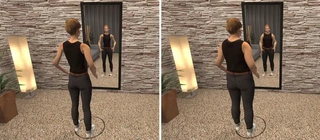
- Self-Observation Distance: The distance for self-observation in a virtual mirror does not significantly affect the perception (i.e., embodiment, body weight, affective appraisal) of embodied personalized avatars within a range of one to four meters, providing design flexibility.
- AR Potential: The work showed that optical see-through AR systems can provide a convincing body ownership comparable to VR, despite lower immersion. This opens the design space for applications that benefit from incorporating the real environment, such as those that require the simultaneous presence of a therapist.
Technical Contributions
The research relied on and resulted in the creation of a sophisticated, customizable XR system. This system enabled users to embody rapidly generated, photorealistically personalized virtual humans whose body weight could be realistically and interactively altered in real-time across different immersion modes.